Showing posts with label honduras. Show all posts

Thursday, October 31, 2013

a good friend and an amazing nurse: Katy Wilson, RN


Hi my name is Katy and I have had the awesome experience to work alongside Amanda in Clinica Esperanza. I am a newly graduated nurse that is volunteering in Roatan for 6 months before I join the “real world.” I have loved getting to spend time here getting to know and work alongside the people of Roatan! I have learned so much from the people and the culture and want to share a little bit about what I have learned.

Currently, I have been in Roatan for 3 months and have had many chances to get to know several of the locals. One of the first things you notice quickly while on the island is the difference in time. In the United States, I was used to rushing from one task to another and if anyone is over 10 minutes late it is considered rude. Here people are not as strict with time. It leads to a more relaxed atmosphere and easier to take more advantages to talk with people or take time to help people. You get your task done in whatever time it takes then move on to the next thing. At times this can be frustrating because I am used to the idea in the States that work comes first and socializing is only if you have enough time. Other times it can be quite refreshing to not have to feel that I have to hurry and finish all my tasks as quick as possible and rush off to the next thing. It has worked wonders for anxiety!
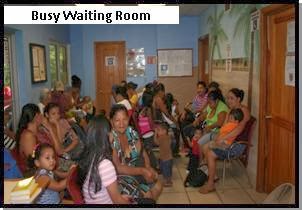

Time can also be seen differently when looking at the clinics in the United States in comparison to the clinics in Roatan. In the United States, people are given an appointment and tend to get very frustrated when they have to wait for 30 minutes beyond their appointment time. In Roatan, Clinica Esperanza does not regularly give appointments but instead the patients arrive early in the morning to get in the front of the line. Some of these patients that need to be seen by the pediatrician and the family practice doctor easily wait 1 hour or more to be seen by the doctor. For the most part, the patients do not complain about having to wait so long to be seen. Instead they are grateful to be given the opportunity to have good and affordable healthcare, and culturally it is not rude to make someone wait or not have an appointment.

Being from the United States, it also amazes me how happy the Hondurans are with so little materialistic goods. I got to visit with a family up in the colonias that was living in a small 2 bedroom “house.” The insulation was simply cardboard boxes shoved behind chicken wire and the “rooms” were sheets thrown over a rope. Another couple of guys I talked to were telling me that they didn’t have any money, yet they were not worried or stressed about what would happen. The people in Roatan learn how to live off the land a lot of the time. Coconuts are everywhere that you can drink the coconut water out of or eat the meat. Fish are plentiful in the ocean and many fruits and vegetables that can be found on the island.

What it all comes down to is that Hondurans view life with a present focused view. It is common to hear islanders say, “We don’t know if we will even be here tomorrow so why worry about it?” They are thankful for each day they live and do not dwell on what the future will hold. In the United States, people tend to focus more on the future. We have to have a good job and lots of money so that we can have a secure future. We worry about what job we will have in the future, and we schedule things out for months. Is one way better than the other? Who am I to judge? I believe there are pros and cons to both and people from both cultures can learn something from the other. Maybe in the United States we should learn to be more thankful for each day we live. Maybe we should enjoy the here and now more rather than always focusing on the future. At the same time, maybe Hondurans should consider the future more when going to school to get a good job. Or maybe make plans to ensure that basic living standards can be provided all the time not just when times are good. Again, who am I to judge?


I hope this post has helped to show you a little bit about life in Roatan! Thank you Amanda for letting me post this and share my insight. I hope this was informative and interesting. If you would like to follow my blog while I am in Roatan, Honduras you can find it at the link below.


Tuesday, October 22, 2013

doctors on strike

For the last two weeks, doctors who work for the public sector have been on strike here in Honduras. More than 700 doctors from 27 public hospitals around the country are demanding pay they have not received since the earlier this year.  The strike was called by the Colegio Médico de Honduras, which is like the association for doctors. They are demanding that these doctors be paid back pay, paid for the time that they have been on strike, and receive an increase in pay. 


ElHeraldo.hn

Last week, the Honduran government declared this strike illegal, saying that the doctors' association did not follow the correct procedures to declare their frustration to the government. The president questioned the ethics of these doctors, saying that those who are suffering most from this strike are the Honduran people who are missing their appointments. The doctors, while agreeing that the Honduran people are absolutely taking a hit by the strike, responded by saying, "We doctors have to eat, too."

The strike is complicated; the in's and out's are a bit confusing due to lots of finger pointing and questions about who's to blame, if the government has money to pay, etc. etc. Everyone is clearly frustrated. What I think is important to emphasize is that this is not the first time this has happened here. Apparently, this happens all the time.

I work with a doctor who works at the public hospital in the mornings as an emergency room doc (the emergency services are still running, thank goodness) and at Clínica Esperanza in the afternoons. When I asked him about the strike he told me, "We have to go on strike. We have to go on strike any time we want to get paid." He hasn't been paid in over six months for his work at the hospital and that this happens all the time; they go for months without pay, they go on strike, they get paid (usually just their normal salary - no increase for their paycheck being late or anything like that). Some people have been without some or all of their pay for as long as a year. 

My response when he told me this:  WHAT!? How do they live??

He said a lot of doctors build up a ton of credit card debt because that's what they have to live on while they wait. He's lucky enough to have another job in a private clinic, so he can always have some income. Some doctors do the same, work in a public hospital as well as a private one, but some do not. 


ElHeraldo.hn

Early last week the government told the doctors' association that if and when this is resolved, there is no money to give them any increase in pay whatsoever, and that they will not be paid for the days they have been on strike. 

Oh, by the way, last Tuesday, the Honduran national soccer team tied Jamaica, qualifying them to go to the World Cup in Brazil next summer. It was a crazy night -- we went down into town to watch the celebration. The president of Honduras declared the following day a holiday for everyone who worked in the public sector to celebrate the victory.  Hmm... the president can afford to give a vacation day to all public employees, but is unable to pay doctors?  Forgive me if I am being naïve, but something doesn't quite add up.

As far as my work in the hospital, it has not been as affected. Two weeks ago  I showed up to the hospital and opened the clinic, only to find out that all our patients had been turned away under the assumption that the pediatrician that I work with was also on strike. Dra. Cerritos came in at her normal time, frustrated, because she was indeed planning on seeing patients all day -- her salary for her work in the hospital is paid for by Global Healing, the organization that brought me here to the island. Technically, she is "on strike" for her other work in the maternity ward, for which she has not been paid, but since babies aren't going to wait until the strike has ended, she, like the emergency room doctors, has continued with her work. Aside from that first day, and the holiday declared because of the soccer win, we have been able to see kiddos regularly thanks to the consistent pay that Dra. Cerritos receives from Global Healing.

Yesterday, doctors agreed to return to work for two weeks after the government agreed to pay them for their work through June or July (I heard saw a couple of different statements about the exact date). After two weeks they intend to go on strike again if their demands have still not been met. 

Tuesday, October 8, 2013

go with the flow

A piece of advice that is often given to travelers is to learn to be very flexible. Often things don't happen on time. Or they don't happen at all. Or they happen in a round-about way that doesn't seem to make any sense and takes a lot more time and maybe doesn't produce the results or arrive at the destination you were looking for but you just have to go with the flow.

While living in Brazil, I learned that when people want things to be done at a specific time (for example, a business meeting), they request that it be done on "American time" (as in, like a person from the United States would do it). It was not uncommon for both students and professors to show up half an hour late (or more... or not at all) to classes. When someone says they'll be there soon, usually that means within the next hour or two, not the next five minutes. Sometimes the bus doesn't show up. Sometimes the metro is broken down. Sometimes there is a strike or a holiday so everything is closed for three days (or more).

It's good to learn to go with the flow, to be able to adapt and figure things out when things don't go exactly as planned.  The idea that "time is money" is pretty deeply ingrained in our culture, and don't get me wrong, I like to have my schedule just as much as any other gringo (you should see my day planner from college... yikes!), but traveling has definitely helped me learn that a schedule can't rule my day or my life.

But how does that translate to healthcare?

In both clinics that I am working in here on the island, appointments are not scheduled at a specific time. You can set up an appointment for a specific day, but you still have to make sure you arrive early enough that your "spot" isn't taken. Dra. Cerritos hands out little tiny signed slips of paper with a date written on it. Patients/parents come back on that day and turn in that little slip of paper to the receptionist, who then gives them an even smaller piece of a paper with a number written on it. That represents their place in line to see the doctor. The doctors only see a certain number of patients every day (Dra. Cerritos sees 15) so if you are not here early enough, you don't get to see the doctor. I have talked to parents who have come as early as 6 in the morning to ensure that they are seen by the doctor. I don't start triage until 8:30. Dra. Cerritos doesn't usually arrive in the clinic until around 10:30 (She works in maternity in the morning with the new mommas), and sometimes it is even later than that. So families are waiting in the heat for literally hours to see the doctor.


I can't tell you how many times a morning parents peek their head in the clinic to ask, will the doctor be seeing patients today? What time does the doctor show up? And I cringe because I have to answer, "Well... usually she's here around 10:30, but sometimes she gets here as early as 8:30 or 9..." More than once, emergencies have come up in the maternity ward and she has had to rush off. In these cases, I have to work up the courage to step out into the little waiting area and tell the parents who have been waiting for hours in the heat with their hot, sick, crying kiddos that the doctor will not be able to see you today. I am so sorry.

The inconsistencies are really tough, and this goes beyond the scheduling. One day, the electricity went out. I was reading babies' weights with a flashlight. And with the electricity, we lost our air conditioning (Global Healing has provided an air conditioner that we get to use inside the clinic). So instead of stepping into a refreshing clinic, families stepped into a hot, dark room with a sweaty volunteer (me) to measure their kiddos. Another day, a different lock had been used to lock the clinic, so I spent all morning looking for the key and started triage late. The first week I was here, we ran out of paper towels so I had to use gauze to wipe down the clinic at the end of the day (PS thank you ALL for those donations.....I have never been so excited for disinfecting wipes). One morning I spent half an hour chasing a tarantula out of the clinic. Yesterday, I showed up at the hospital to find out that the specialized doctors had gone on strike after not receiving their pay. All of Dra. Cerritos' patients were turned away by the receptionist, which shouldn't have happened -- She is part of the hospital staff, but her salary from the pediatric clinic is paid for by Global Healing.

I've said it before, but to my foreign eyes all of this can feel a bit chaotic. It is good to see some of these inconsistencies alleviated by Global Healing. Today, thanks to the consistent paycheck from them, we will be able to see 15 patients while the other pediatric doctors do not.  As far as all the other surprises, I guess I'll just keep going with the flow.

Saturday, September 7, 2013

On my way to Roatán!!!

Hello from Houston, Texas! I’m finally on my way to Roatán. I left Denver at 6 this morning -- yikes! Thanks, Mom and Dad for waking up to take me!! And I really did need their help… I am bringing with me over $2000 worth of donated medical and school supplies!!!!!!!!!! About half of these donations are from friends and family in the Denver area, and the other half is a donated Project C.U.R.E. kit.

This is what 100 pounds of donations looks like!


making sure it was under the weight limit—is there a better way to do this?


and here it all is changing flights at Houston (The two giant green-grey duffle bags. Photos taken from my seat in the airplane.)

So now I’m in Houston and (thank you, coffee) I am able to think about the last couple months and the months ahead. I have already learned so much just by preparing for this experience, and first and foremost, I have learned about the incredible generosity of people, so allow me a moment to give a shout-out to the Castle Rock High Noon Rotary Club, First Presbyterian Church in Boulder, the Castle Pines Rotary Club, Project C.U.R.E. and countless friends and family. I could not be in this airport today without the support (financial and otherwise) of my community.

A lot of people have asked me what I am most excited about. Aside from, um.. EVERYTHING, I am really excited to start to learn about some of the nitty-gritty of healthcare. In the reading and research I’ve done this summer, especially focused on international health outreach (which included some books and lots of reading news articles and blogs about international development, e-mailing or sending twitter messages (seriously) to people who write those articles and blogs) I really feel like I have only barely begun to attempt to scratch the surface of learning what healthcare outreach looks like. This is a little overwhelming (and very humbling). But now, the opportunity is in front of me to see what a couple of these organizations actually look like in action – and I get to be a part of that action! THAT is the thing I am most looking forward to. This opportunity to work in Roatán is a chance to get my foot in the door in the kind of work I see myself doing for a long time.

But, you know, I’m only in Houston now J I’ll be updating from Roatán soon!

Tuesday, August 13, 2013

Global Healing, RVPC, & HEAL


This whole business with Roatán, Honduras came to be because earlier this summer, I was accepted as the HEAL intern for the Roatán Volunteer Pediatric Clinic. The clinic is run by Global Healing, which is an organization that goes into developing parts of the world to establish programs to promote health care reform where modern medical care is often not available. What is key about Global Healing is that they aim to create sustainable programs. It’s not just about short-term interventions, but it’s about creating long-lasting relationships with the communities they work in to become self-sufficient programs. Global Healing has programs in Georgia, Armenia, Dominica, Moldova, Nepal, Haiti, Ukraine, and (ta-da!) Honduras.

Global Healing came to Honduras in 2003, opening the Roatán Volunteer Pediatric Clinic. The clinic is based out of the Public Hospital, of which there is one on the island of a population of around 65,000. With the government only able to support one permanent pediatrician, the hospital could not meet the demands of the pediatric outpatients, and often patients were turned away. So Global Healing stepped in to relieve this demand. The clinic is staffed by volunteer physicians from the US, and there are year-round rotations for pediatric resident physicians as well as a Health Education and Advocacy Liaison interns (HEAL - that’s me!). The RVPC provides perinatal care, newborn care, and inpatient pediatrics.

The HEAL intern serves as the Clinic Coordinator, locating resources (i.e. meds, specialty referrals, etc.) for patients, helping them through the logistics of utilizing these resources (i.e. locating funding for trips to the mainland for follow-up care). Interns assist in setting up the clinic before patients arrive, triage as patients and their families come into the clinic, collecting patient data, and interpreting for Global Healing physicians.

I will also have the opportunity to work with long-term patients individually, coordinating care among many health care providers and locating resources where there may not seem to be many – this is the aspect of the internship that most excites me. I am excited to get to know patients and families better to be part of creating a care plan that is best for them, and I’m hoping to get to know the community and the culture well so that I can learn how to personalize care for every person.

In an effort to help the clinic, I am now trying to gather donations of all sorts to take with me. Below is the list of things that the clinic always needs. I’ll be collecting in the Denver/Boulder/Colorado Springs area until I leave – please contact me or leave a message below if you’re interested in donating

25 days and counting…!


Non-prescription Medications & Supplies
  • Infant and children's acetaminophen
  • Infant and children's liquid cold
  • medication (e.g., pseudoephedrine)
  • Ibuprofen (liquid or infant drops)
  • Benadryl (liquid preferred)
  • Hydrocortisone ointment or cream
  • Topical antibiotic ointment
  • Selsun Blue shampoo
  • Anti histamine ointment or cream
  • (anti-itch cream)
  • Eucerin or other moisturizing creams
  • A&D, Desitin, or other diaper creams
  • Vaseline petroleum jelly
  • Cetaphil lotion
  • Oral calcium supplements
  • Children’s vitamins
  • Debrox ear drops
  • Clotrimazole (Lotrimin) ointment
  • Saline bullets
  • Individual alcohol rubs
  • 3cc & 5cc syringes
  • Nizoral shampoo
  • Nix (lice treatment)
  • Silver Nitrate applicators
  • Urinalysis dip-sticks
  • Glucometer / glucometer strips
  • Thermometers (no mercury)
  • Ear thermometer w/covers
  • Infant nasal suction bulbs
  • Pulmo-Aide or other nebulizers

General Donations
  • Infant formula
  • Preemie, infant, and baby pampers
  • Combs
  • Shampoo, Conditioner, & soaps
  • Toothbrushes & toothpaste
  • Sandals, shoes, flip flops
  • Clothes
  • Socks
  • Children’s stickers
  • Small Toys and Stuffed Animals
  • Writing Utensils
  • Spanish & English kids’ books
  • Notebooks
  • Child backpacks
  • Crayons and coloring books
  • Hand Towels
  • Kleenex, Paper Towels
  • Nail Clippers
  • Sports Equipment: Soccer Balls
  • Pumps for balls
  • Flashlights (ones that do not need batteries)

Clinic Supplies
  • Antibacterial hand gels
  • Paper towels
  • 409 disinfectant sprays
  • Plastic Ziploc bags
  •     (little ones most needed)
  • Print cartridges (HP cartridges 21 and 22 for HP Deskjet D1460 printer)
  • Printer paper

Prescription Medications
  • Ceftriaxone for injection
  • Any oral antibiotics (liquid preferred)
  • Amoxicillin
  • Augmentin
  • Azithromycin
  • Clarithromycin
  • Erythromycin
  • Cefazolin
  • Other cephalosporins
  • Penicillin
  • Dicloxacillin
  • Ciprofloxacin
  • Metronidazole
  • Topical Bacitracin
  • Topical Neosporin
  • Nystatin ointment
  • Cortisporin otic suspension
  • Erythromycin ophthalmic ointment
  • Albuterol/salbutamol liquid for nebulization
  • Albuterol etered dose inhalers (MDIs)
  • Permethrinor Lindane (for scabies)
  • Topical Sterids
  • Oral steroids
  • Prednisolone
  • Prednisone
  • Dexamethasone
  • Dexamethasone for injection
  • Inhaled steroid MDIs
  • MDI spacers

Wednesday, July 31, 2013

Honduras and Roatán


This is Honduras and the island of Roatán, just north of the mainland:


Honduras’ history is, well, tumultuous.  The country, with it’s numerous military coups (the most recent being in 2009), has had a history of fairly consistent political instability, corruption, and power struggle. The country is known for its gang activity (but hopefully steps are moving in the right direction) and for the brief but violent 1969 Guerra de Fútbol (the “Soccer War”: rooted in immigration and economic issues between Honduras and El Salvador, the first acts of violence of the war occurred between fans at a World Cup qualifying match between the two teams).

True, Honduras is known as a violent country. But that is not the only thing for which it’s known. The Maya civilization thrived in the western part of the country, and there are ruins to visit in Copán.  There are many tropical national parks to explore. The country’s economy is largely dependent on its export of bananas and coffee, and, in more recent years, on tourism.

And tourism, of course, is how many know of the island of Roatán.

The Bay Islands, which include Roatán, Utila, and Guanaja, are considered culturally worlds apart from the mainland with a mixed heritage of African, Carib, and European.  In the 1700s, the islands were a hotspot for English, Dutch, and French pirates. The islands were under the control of Great Britain until 1859, when they were ceded to Honduras. English is still largely spoken on the islands, but because of the recent increase in tourism, many people from mainland Honduras have come to the islands in search of work speaking Spanish, which is becoming more and more prominent.

I had the opportunity to visit Roatán this May with my family and friends. It is beautiful. It certainly has that laid-back “island” feel.  The island runs on tourism, and it shows. There were large, gated hotels and resorts all along road leading to the east end of the island and countless billboards and signs advertising ziplines, restaurants, and diving (Roatán is world-renown for it’s diving. The Mesoamerican Reef is the second-largest barrier reef in the world). 

Alongside these hotels and billboards, however, sits dilapidated homes and shops. Police officers randomly pull people over for no reason but to demand payment in order to pass (the folks who own the houses we stayed at paid the police a monthly “fee” so that they would not stop the cars that carried those who rented from them … aka, us). I don’t know if I am wise enough or smart enough to make any kind of conclusion or judgment about these kinds of situations, but I see them. In any case, I’m sure this will be something I will continue to think about after I spend more time there.

In the meantime, here are some more photographs to get an idea about what I can expect… countdown: 38 days!