Showing posts with label el hospital público. Show all posts

Tuesday, December 3, 2013

all the small things

I’ve been here for three months. It’s been a big three months. But today I want to think about all the small things. These are the simple, important, amazing things that together have made this experience so big for me.

Organizing patient files and learning the importance of decent, legible handwriting. It really is important to the time to write a person's name and their history so that the next person who touches the file can understand what happened... I know it's kind of a long-standing joke that people who work in healthcare have really bad handwriting, but seriously folks, decent handwriting really goes a long way.


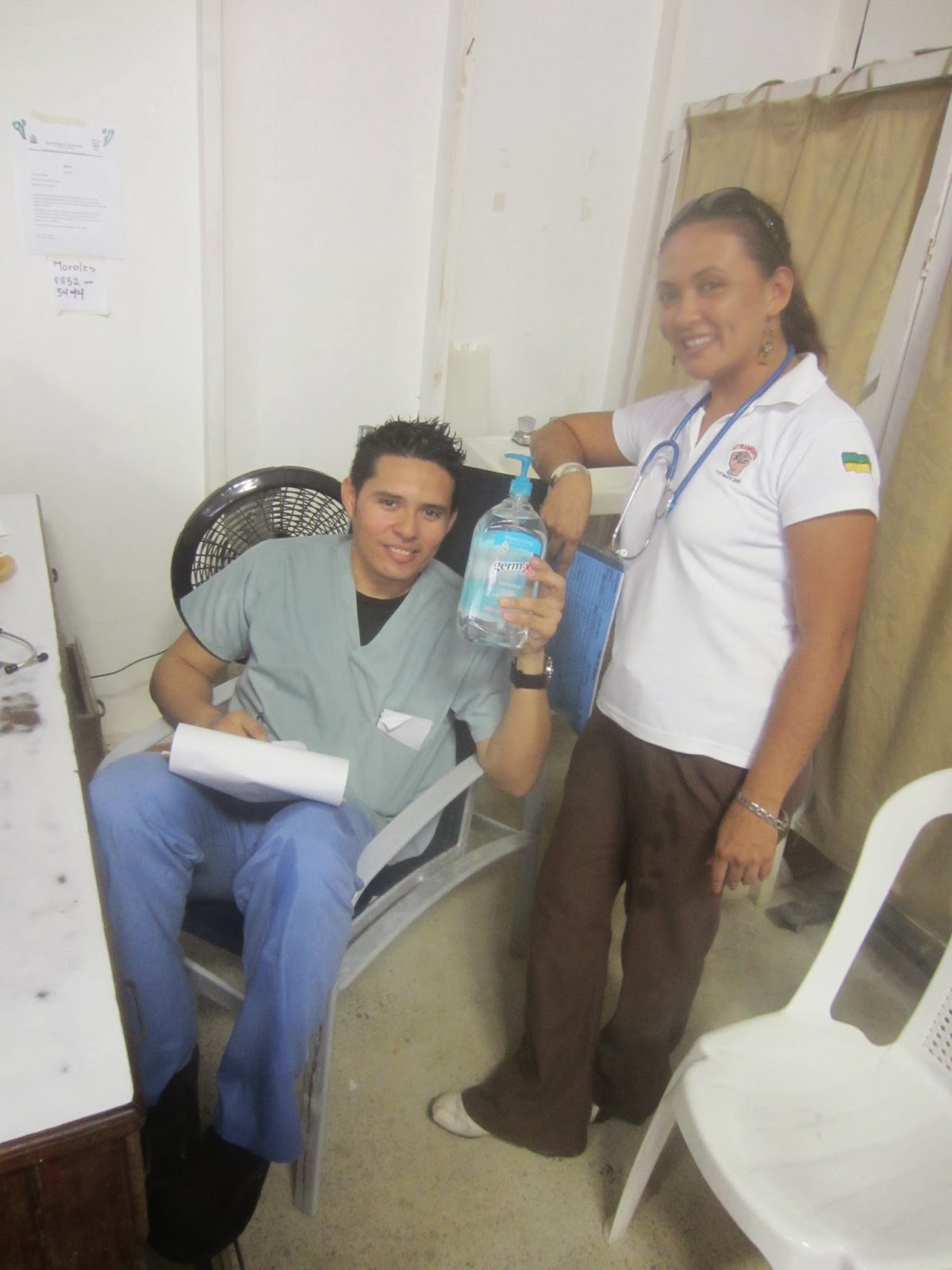
Handwashing. I spent a day teaching all the kids (and their parents) who came through the clinic how to properly wash their hands and the importance of handwashing. These big bottles of hand sanitizer were purchased through a very generous donation and distributed throughout the hospital. The hospital staff was so grateful – There are few places in the hospital to wash your hands and the running water doesn’t always work. This donation was so important to the hospital!
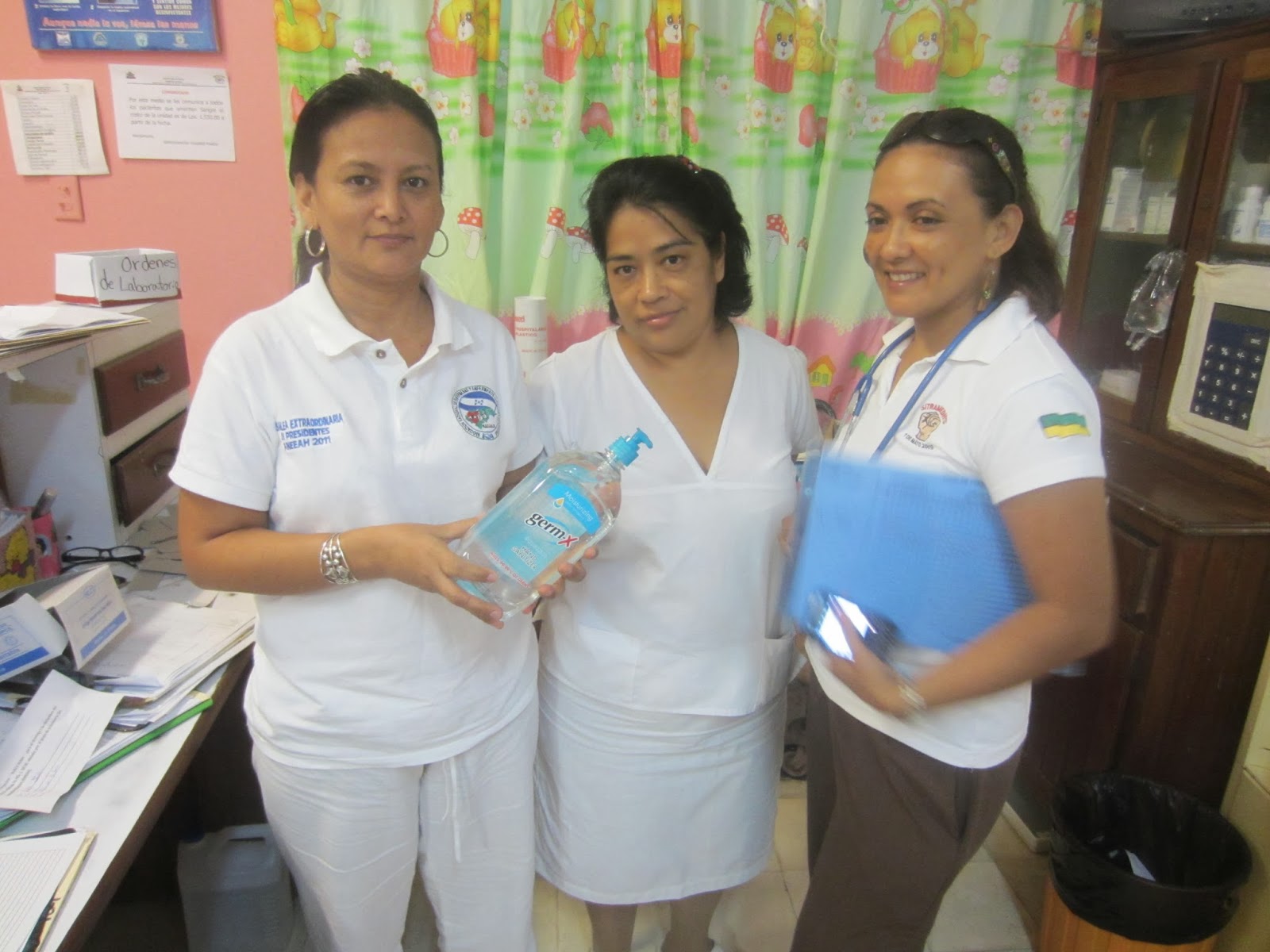
in the pediatric ward

in the maternity ward

in the dengue clinic


Weighing and measuring with accuracy. This is one of those things that I do over and over and over again all day at the hospital. Weigh and measure kiddos. But these numbers are what help the docs determine if kids are healthy, if something is not right, how much medication to prescribe… height, weight, temperature, head circumference, these are important numbers that have to be accurate.


Cleaning supplies. These were another donation that has made a big deal. When I got here we were running out a of this. Thanks to this donation, we have not had to spend money (that is not so easy to obtain) to purchase more cleaning supplies, and there will still be some here to use for a few months after I leave.

 
All the little touches. A cover for the baby scale. A bookshelf to hold books and informational pamphlets for families to read while they wait to see the doctor (and, as I’ve said before, they wait hours and hours). These are the things that seem small, but a lot of work and love and kindness of friends and strangers went into making them available for this clinic.


I am so thankful for the small things.


Tuesday, October 22, 2013

doctors on strike

For the last two weeks, doctors who work for the public sector have been on strike here in Honduras. More than 700 doctors from 27 public hospitals around the country are demanding pay they have not received since the earlier this year.  The strike was called by the Colegio Médico de Honduras, which is like the association for doctors. They are demanding that these doctors be paid back pay, paid for the time that they have been on strike, and receive an increase in pay. 


ElHeraldo.hn

Last week, the Honduran government declared this strike illegal, saying that the doctors' association did not follow the correct procedures to declare their frustration to the government. The president questioned the ethics of these doctors, saying that those who are suffering most from this strike are the Honduran people who are missing their appointments. The doctors, while agreeing that the Honduran people are absolutely taking a hit by the strike, responded by saying, "We doctors have to eat, too."

The strike is complicated; the in's and out's are a bit confusing due to lots of finger pointing and questions about who's to blame, if the government has money to pay, etc. etc. Everyone is clearly frustrated. What I think is important to emphasize is that this is not the first time this has happened here. Apparently, this happens all the time.

I work with a doctor who works at the public hospital in the mornings as an emergency room doc (the emergency services are still running, thank goodness) and at Clínica Esperanza in the afternoons. When I asked him about the strike he told me, "We have to go on strike. We have to go on strike any time we want to get paid." He hasn't been paid in over six months for his work at the hospital and that this happens all the time; they go for months without pay, they go on strike, they get paid (usually just their normal salary - no increase for their paycheck being late or anything like that). Some people have been without some or all of their pay for as long as a year. 

My response when he told me this:  WHAT!? How do they live??

He said a lot of doctors build up a ton of credit card debt because that's what they have to live on while they wait. He's lucky enough to have another job in a private clinic, so he can always have some income. Some doctors do the same, work in a public hospital as well as a private one, but some do not. 


ElHeraldo.hn

Early last week the government told the doctors' association that if and when this is resolved, there is no money to give them any increase in pay whatsoever, and that they will not be paid for the days they have been on strike. 

Oh, by the way, last Tuesday, the Honduran national soccer team tied Jamaica, qualifying them to go to the World Cup in Brazil next summer. It was a crazy night -- we went down into town to watch the celebration. The president of Honduras declared the following day a holiday for everyone who worked in the public sector to celebrate the victory.  Hmm... the president can afford to give a vacation day to all public employees, but is unable to pay doctors?  Forgive me if I am being naïve, but something doesn't quite add up.

As far as my work in the hospital, it has not been as affected. Two weeks ago  I showed up to the hospital and opened the clinic, only to find out that all our patients had been turned away under the assumption that the pediatrician that I work with was also on strike. Dra. Cerritos came in at her normal time, frustrated, because she was indeed planning on seeing patients all day -- her salary for her work in the hospital is paid for by Global Healing, the organization that brought me here to the island. Technically, she is "on strike" for her other work in the maternity ward, for which she has not been paid, but since babies aren't going to wait until the strike has ended, she, like the emergency room doctors, has continued with her work. Aside from that first day, and the holiday declared because of the soccer win, we have been able to see kiddos regularly thanks to the consistent pay that Dra. Cerritos receives from Global Healing.

Yesterday, doctors agreed to return to work for two weeks after the government agreed to pay them for their work through June or July (I heard saw a couple of different statements about the exact date). After two weeks they intend to go on strike again if their demands have still not been met. 

Friday, September 27, 2013

parents of sick kids

At least once a day, if not two or three times a day, a parent asks specifically to see Dr. Cerritos. We currently have a doctor here, Dr. Mark, who is doing a rotation and has been here for three weeks. He also sees patients, allowing us to see twice as many a day, but some parents simple say no. They want to be seen by Dr. Cerritos.

I was curious, so I started asking parents why they wait, even if it means waiting an hour or two longer. One woman told me, "Dr. Cerritos know the entire history of my son. She has known him since he was born. When he was born, he and I were both very sick. I nearly died. She has been with us from the very beginning and she will always be my child's doctor".  Another mother told me she really believes Dr. Cerritos is a great doctor. She told me she has also been coming to this clinic since her daughter was born. She trusts Dr. Cerritos because she checks everything: "She doesn't just look at my daughter then write a prescription on a piece of paper. She looks all over her body. She makes sure her whole body is healthy."

These parents are just like all parents all over the world. They want the best for their kids and they know that a consistent pediatrician is important. Parents always ask me questions about their kids' weight, height, is it normal? We use CDC growth charts to keep track of height and weight for kids as they grow up, and they are a great tool to show parents how their child's growth compares to an average child and at what point they should be concerned, and I always tell them they should bring any concerns up with the doctor. 

Usually, we see moms or grandmothers bringing in their kids, but every once and while, I see dads, brothers, sisters, aunts and uncles.

We've had a couple very sick kids over the last week, and with them come some very scared, nervous parents and family. One little teeny tiny preemie baby was here, just a couple of weeks old and only 5 pounds. He had a cough and had a lot of difficulty breathing. Dr. Cerritos listened closely and carefully and spent a lot of time with this little baby. It broke my heart to see that little baby and his mother, who looked so sad and scared. She sat there with her baby in her hands and cried. Dr. Cerritos had the baby admitted to the pediatric in-patient unit in the hospital. Another kiddo came in with x-ray results showing a fractured skull. Upon hearing this from the doctor, the sister (who was the one who had brought the little boy) gasped and covered her mouth with shock. She held back her tears as Dr. Cerritos signed a pass for her to take the ferry to the mainland; she needed to go to the hospital in San Pedro Sula, today, as soon as possible, to see a neurosurgeon there, and it was important that they admit the child today. The fear (and sometimes guilt) that comes up for these family members is heartbreaking. They just want their child to be healthy.

Last week a sick baby was in here for a long time with Dr. Cerritos with a very high fever. She was admitted to the hospital. This week, her mom came into the clinic, carrying her baby girl with her. She was beaming. Her baby was doing much better and they had been able to go home. She wanted to come thank Dr. Cerritos for her care and to show off her happy, healthy baby girl.

It is so good to see parents who care about their kids. I'm hoping to find some materials for parents to read while they are waiting those 2-3 hours and make a reading shelf to put in the waiting area. It will (hopefully) include coloring and reading books for kids along with educational materials for parents. If anyone knows how to get a hold of books, magazines, pamphlets, or flyers in Spanish about family health, I'd be interested to hear! I know these parents want the best for their kids; they seek out good pediatricians and stick with them and ask good questions, and better informed parents will have healthier kiddos!

Wednesday, September 18, 2013

Information Overload & Independence Day

I’ve been in Roatán for a little over a week. It’s been exhausting (mostly due to information overload) but it has been really good.


one room
Last week, I got a good taste of what the next three months will be like: in the mornings I’ll be in the public hospital in Coxen Hole at a pediatric clinic with Dra. Cerritos, a Honduran pediatrician. There, the core part of my day is spent doing triage before Dr. Cerritos sees patients. I weigh babies and kiddos, measure heights and head circumferences, take temperatures, hand out stickers and tickle tummies. After the doctor (or doctors – right now we have a doctor here doing a rotation with the clinic, which is super helpful; we can see twice as many patients every day!) sees patients, I enter the data from the visits into a database that keeps track of who we see, where they’re from, and the doctor’s diagnosis and recommendations.

this is where I weight & measure kiddos
the other room
waiting area
The hospital is so different than what I’m used to. It is unbelievably hot. People are everywhere. While doctors are seeing patients, other patients and nurses and doctors walk in and out of the room. It feels… chaotic. All of this, of course, is through the eyes of foreigner. Of course it feels different. But it does not feel unsafe. Doctors and nurses are caring for their patients, and caring for them very well, with the few resources they have. The hard part is that they have few resources.


Nursing Education
On Thursday and Friday, I sat in on a couple of classes that were given by three nurse educators who came down for Global Healing to look at how they might expand their outreach in the hospital. The classes were for nurses and covered care for diabetes patients, and care for low birth weight babies. One of the educators mentioned that she has seen nurses sit with a baby for an hour without leaving their side to monitor the baby’s health. A Honduran nurse spoke up, saying there is no way they would have to sit with one patient for an hour. Later, the question of hand washing came up – The hospital has few sinks with functioning water and I have yet to see a dispenser for antibacterial gel. The nurses recognize that they don’t always use the best hand washing techniques between every patient, sometimes they don’t make it to the sink, or there is no soap, or whatever. They fully understand the importance of washing their hands (they spend just as much time in nursing learning to wash their hands as we would in the USA—and any nursing student would tell you it’s the first thing you learn), but how can they wash their hands properly when they don’t have soap? Or antibacterial gel?

These are my initial observations. It is hard to see some of these things, and it’s important to see them. But equally (if not more) important is seeing that these professionals want to care for their patients in the best way possible, and they are trying to do so. As far as my role as a volunteer in all of this, I’m not sure what to think exactly, except that I am going to learn a lot. If anyone has any insight, I would love to hear it. All these things have been tumbling around my head all week. Luckily I’ve been able to chat about it with other volunteers, but I’d love to hear what friends and family back home think about this, or experiences they’ve had. 

So yes, it’s been exhausting. But I have been incredibly blessed to be living with an amazing, welcoming family who I have no doubt will take really good care of me while I’m here. They’ve showed me around the island, introduced me to their family, and have made me some amazing food (Doris’ baleadas are AMAZING!!). Sunday was Independence Day here, and this weekend was full of festivities, including several parades.


One week has already been eye opening… it’s going to be an interesting three months.