Showing posts with label clinica esperanza. Show all posts

Friday, November 8, 2013

nutrition & health on the island

This week, I had the pleasure of assisting with a nutrition class in the community of Mud Hole here on the island.


Elizabeth, a Registered Dietitian from Canada, has been here for 3 months conducting research about what foods the locals eat and how they prepare it.


In response to her research, Elizabeth designed a simple, interactive, and free nutrition class for the residents of Mud Hole. Since I speak Spanish, she asked me to come help teach the class.


We chatted about distinguishing between healthy and unhealthy foods, the Plate Method, how to eat healthy on a budget, and the effects of soda on our bodies. We even served a healthy snack of carrot sticks with lime and a pinch of salt. It was a blast!


 I'm a big believer that a healthy diet is one of the best ways to prevent disease and promote health in our lives.  Props to Elizabeth for all her hard work preparing the class. It was definitely a success! It was great to participate in a class that taught simple changes that can have big impacts -- As a nurse one day, that is definitely what I want to be about! Check out Elizabeth's blog to see all the work and research she's done: http://dietitianinroatan.wordpress.com/


Thursday, October 31, 2013

a good friend and an amazing nurse: Katy Wilson, RN


Hi my name is Katy and I have had the awesome experience to work alongside Amanda in Clinica Esperanza. I am a newly graduated nurse that is volunteering in Roatan for 6 months before I join the “real world.” I have loved getting to spend time here getting to know and work alongside the people of Roatan! I have learned so much from the people and the culture and want to share a little bit about what I have learned.

Currently, I have been in Roatan for 3 months and have had many chances to get to know several of the locals. One of the first things you notice quickly while on the island is the difference in time. In the United States, I was used to rushing from one task to another and if anyone is over 10 minutes late it is considered rude. Here people are not as strict with time. It leads to a more relaxed atmosphere and easier to take more advantages to talk with people or take time to help people. You get your task done in whatever time it takes then move on to the next thing. At times this can be frustrating because I am used to the idea in the States that work comes first and socializing is only if you have enough time. Other times it can be quite refreshing to not have to feel that I have to hurry and finish all my tasks as quick as possible and rush off to the next thing. It has worked wonders for anxiety!


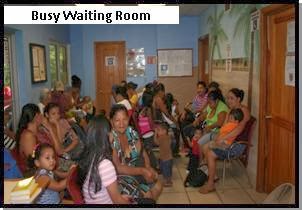
Time can also be seen differently when looking at the clinics in the United States in comparison to the clinics in Roatan. In the United States, people are given an appointment and tend to get very frustrated when they have to wait for 30 minutes beyond their appointment time. In Roatan, Clinica Esperanza does not regularly give appointments but instead the patients arrive early in the morning to get in the front of the line. Some of these patients that need to be seen by the pediatrician and the family practice doctor easily wait 1 hour or more to be seen by the doctor. For the most part, the patients do not complain about having to wait so long to be seen. Instead they are grateful to be given the opportunity to have good and affordable healthcare, and culturally it is not rude to make someone wait or not have an appointment.

Being from the United States, it also amazes me how happy the Hondurans are with so little materialistic goods. I got to visit with a family up in the colonias that was living in a small 2 bedroom “house.” The insulation was simply cardboard boxes shoved behind chicken wire and the “rooms” were sheets thrown over a rope. Another couple of guys I talked to were telling me that they didn’t have any money, yet they were not worried or stressed about what would happen. The people in Roatan learn how to live off the land a lot of the time. Coconuts are everywhere that you can drink the coconut water out of or eat the meat. Fish are plentiful in the ocean and many fruits and vegetables that can be found on the island.

What it all comes down to is that Hondurans view life with a present focused view. It is common to hear islanders say, “We don’t know if we will even be here tomorrow so why worry about it?” They are thankful for each day they live and do not dwell on what the future will hold. In the United States, people tend to focus more on the future. We have to have a good job and lots of money so that we can have a secure future. We worry about what job we will have in the future, and we schedule things out for months. Is one way better than the other? Who am I to judge? I believe there are pros and cons to both and people from both cultures can learn something from the other. Maybe in the United States we should learn to be more thankful for each day we live. Maybe we should enjoy the here and now more rather than always focusing on the future. At the same time, maybe Hondurans should consider the future more when going to school to get a good job. Or maybe make plans to ensure that basic living standards can be provided all the time not just when times are good. Again, who am I to judge?


I hope this post has helped to show you a little bit about life in Roatan! Thank you Amanda for letting me post this and share my insight. I hope this was informative and interesting. If you would like to follow my blog while I am in Roatan, Honduras you can find it at the link below.


Friday, August 23, 2013

Clínica Esperanza


In the last post, I wrote about Global Healing and the Roatán Volunteer Pediatric Clinic, where I’ll be interning most of the day during my time in Roatán. After RVPC closes in the afternoon, however, I’ll be volunteering at Clínica Esperanza.

When I was in Roatán in May, I went by Clínica Esperanza (“Hope Clinic”) on a whim to see if I could just check it out. My mom, my friend Elyssa, and I walked shyly into the reception area (me first, mom and Elyssa no hablan mucho español…), but once we were inside we found there was no reason to be shy. The receptionist greeted us warmly and found Karla, the sweetest, kindest, friendliest nurse I’ve ever met. She spoke mostly in Spanish, but tried to speak some English to help my mom and Elyssa understand (mom was very thankful). Nurse Karla gave us a tour of the facility and told us a little bit about how it started. Peggy Stranges, an American nurse who had previously volunteered in Roatán, permanently relocated to the island in 2001. Nurse Karla told us that when Nurse Peggy arrived on the island, locals learned she was a nurse and came to her for medical advice, and thus the idea for the clinic was born. It began in the basement of her home, and then was moved to a church, then eventually moved into it’s own freestanding facility. And folks, this facility is really quite lovely.

Clínica Esperanza’s services include a walk-in medical clinic, women's health center, pediatrics inpatient hospital, birthing center (brand new!), and adult and pediatrics dental clinics with support from a laboratory and pharmacy. They also have outreach clinics and community health education programs. All of these services are low-cost/no-cost to their patients. It's about $5 for a visit, but Nurse Karla told us that no one is ever turned away because they cannot pay. Sometimes they just pay a portion if they can. Sometimes they pay nothing and say they will pay later when they have the money, which sometimes happens and sometimes does not. The clinic runs on donations and has a permanent staff (like Nurse Karla, who is from Roatán) and volunteer doctors, nurses, and students who come and go. This is a great, brief video about Clínica Esperanza and Nurse Peggy:


I feel very fortunate to be able to see two different kinds of healthcare outreach during my time in Roatán. The clinics seem so different (the public hospital where RVPC is located is a concrete slab of a building the bustling “downtown” area, Clínica Esperanza is air conditioned…). I am less certain about what I will be doing with Clínica Esperanza, but I’m really interested in learning more about the outreach programs they offer; public health and health education sounds right up my alley. I also hope that I can lend my language skills to any volunteers who don’t speak Spanish.

Like RVPC, Clínica Esperanza is always looking for medical and financial donations, so if you’re interested in learning more about how you can support the clinic, contact me or check out ClinicaEsperanza.org.


Oh yeah… two weeks from tomorrow I’ll be on a plane!!